
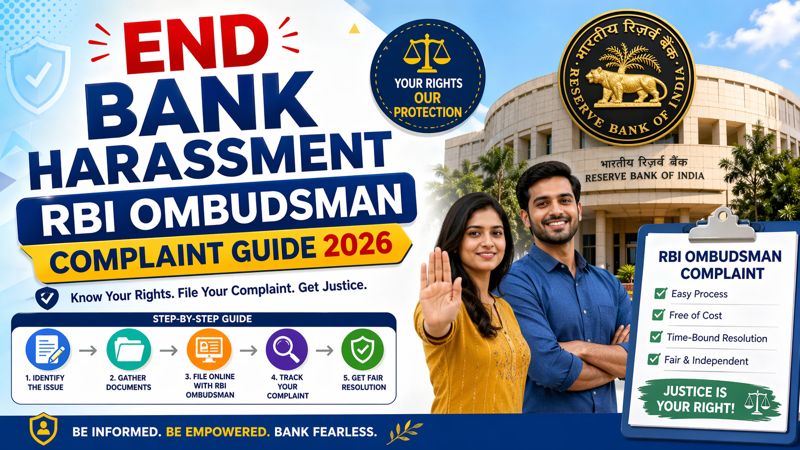
End Bank Harassment: RBI Ombudsman Complaint Guide 2026
If loan recovery calls, threats, public embarrassment, or constant pressure are breaking your peace at home, this RBI Ombudsman complaint guide is for you. Middle-class borrowers in India often feel trapped between unpaid EMIs, family stress, and aggressive recovery behaviour. You are not helpless, and you do have legal options.
In 2026, the RBI Ombudsman complaint process remains one of the most practical ways to challenge unfair bank or NBFC behaviour, especially when your written complaint is ignored or handled badly. This page explains your legal rights, when to complain, what proof to keep, and how to act fast without panic.
You are not weak. You are under pressure.
When a bank, NBFC, or recovery agent starts calling repeatedly, speaking rudely, contacting relatives, or threatening action without proper process, the pressure feels personal. People lose sleep. They stop answering unknown numbers. They hide the problem from family members because they fear shame more than the EMI itself.
That is exactly why borrower-rights awareness matters. According to RBI guidelines, lenders should not resort to undue harassment, including persistently bothering borrowers at odd hours or using muscle power for recovery. [Source]
7 Legal Rights to Stop Illegal Recovery
1You have the right to complain to the bank or NBFC first, in writing
Before going to the RBI Ombudsman, you should send a written complaint to the regulated entity. If it does not reply within 30 days, rejects the complaint, or gives an unsatisfactory response, you can escalate the matter to the RBI Ombudsman. This written first step is crucial because it proves you gave the institution a fair chance to fix the problem. [Source]
2You cannot be subjected to undue harassment
RBI’s Fair Practices Code says lenders should not harass borrowers by persistently bothering them at odd hours or using muscle power. So if the recovery process turns abusive, humiliating, or threatening, you may have grounds to complain. [Source]
3Recovery agents must be identifiable and properly authorised
RBI says banks should inform borrowers when a case is forwarded to a recovery agency, and the agent should carry the notice, authorization letter, and identity card. If someone appears at your home or office without clear identification, you should be cautious and document everything. [Source]
4Your pending grievance should not be brushed aside
RBI’s recovery agent circular says that where a grievance or complaint has been lodged, banks should not forward cases to recovery agencies until that grievance is finally disposed of, except in cases they can prove are frivolous or vexatious. This is a powerful protection for borrowers facing active harassment while a complaint is still pending. [Source]
5Repossession and seizure must follow legal process
RBI’s circular refers to the Supreme Court view that recovery of loans or seizure of vehicles must be done only through legal means. Where security enforcement is involved, lenders should rely on lawful remedies and proper contractual or statutory process, not intimidation. [Source]
6The RBI Ombudsman complaint process is free and can include compensation
Under the RBI Integrated Ombudsman Scheme FAQs, filing is free. The Ombudsman may award compensation up to ₹1 lakh for harassment, mental agony, time lost, and related expenses. Complaints involving direct loss are separately admissible up to the RBI’s stated monetary limit. [Source]
7Threats, abuse, and intimidation may also trigger criminal remedies
If a recovery agent threatens injury to your person, property, or reputation to force payment, Section 351 of the Bharatiya Nyaya Sanhita, 2023 on criminal intimidation may become relevant. Section 352 covers intentional insult with intent to provoke breach of peace. For women borrowers, repeated following or repeated unwanted contact may also raise issues under Section 78 on stalking. In serious cases, preserve evidence and speak to the police or a lawyer immediately. [Source]
How to File an RBI Ombudsman Complaint in 2026
The RBI Integrated Ombudsman Scheme follows a simple logic: first complain to the bank or NBFC, then escalate if they fail you. It works on a One Nation One Ombudsman approach, so you do not need to hunt for a specific city office yourself. [Source]
- Send a written complaint to the bank or NBFC. Use email, customer care, grievance portal, or nodal officer. Mention account number, incident dates, and what relief you want.
- Wait up to 30 days. If there is no reply within 30 days, or the reply is incomplete, unfair, or unsatisfactory, move to the RBI Ombudsman. [Source]
- File the complaint with RBI. You can use the RBI CMS portal at cms.rbi.org.in, send it by email to crpc@rbi.org.in, or post it to the Centralised Receipt and Processing Centre, 4th Floor, Reserve Bank of India, Sector-17, Central Vista, Chandigarh – 160017. [Source]
- Add full facts and evidence. RBI says your complaint should include your contact details, the regulated entity’s branch or office details, facts of the case, representation already made, loss caused, and relief sought. [Source]
- Track your complaint. Once registered, RBI sends a complaint number. You can track status through the CMS portal. For general complaint assistance, RBI also provides contact support on toll-free 14448. [Source]
- Keep your relief realistic. Ask for a stop to harassment, proper response, correction of conduct, compensation if applicable, and documented closure. Do not frame it only as “waive my loan” because pure commercial decisions are often outside maintainable complaint grounds. [Source]
Documents Checklist Before You Escalate
- Copy of your complaint sent to the bank or NBFC
- Reply received, if any
- Loan account number and sanction details
- Call logs, recordings, screenshots, and threatening messages
- Photos or videos of any visit by recovery agents, if safely available
- Any notices, emails, legal letters, or repossession papers
- ID proof and address proof, if needed for complaint submission
- A short one-page chronology of what happened and when
Need immediate help to stop recovery pressure?
If your family is under stress, your phone is ringing nonstop, or recovery behaviour has crossed the line, act before the situation worsens. The fastest move is to document the harassment and take the right complaint path now.
Trusted support line: helping stressed borrowers take the next legal step with clarity, dignity, and urgency.
Frequently Asked Questions
Can I file an RBI Ombudsman complaint for bank harassment?
Yes. Agar issue abusive recovery, unfair handling, ya no proper response se juda hai, to aap pehle bank/NBFC ko written complaint bhejo. 30 din mein reply na aaye, ya reply weak ho, to RBI Ombudsman ke paas ja sakte ho.
When can I complain to the RBI Ombudsman?
Pehle bank ya NBFC ko written complaint do. Agar 30 din tak answer nahi aata, ya problem solve nahi hoti, tab RBI CMS portal, email, ya post se complaint file karo.
Is the RBI Ombudsman complaint free?
Haan, bilkul free hai. RBI ke FAQs ke mutabik filing aur resolution dono ke liye customer se fee nahi li jati.
Can recovery agents call me at odd hours?
Nahi. RBI guidelines ke hisaab se undue harassment allowed nahi hai. Odd hours par baar-baar call karna ya intimidating recovery style use karna complaint ka ground ban sakta hai.
Can the RBI Ombudsman give compensation for mental harassment?
Haan. RBI Ombudsman mental agony, harassment, time loss aur related expense ke liye up to ₹1 lakh tak compensation award kar sakta hai, scheme conditions ke subject to.
What should I do if a recovery agent threatens or abuses me?
Saboot bachao: recording, screenshot, call log, message. Bank/NBFC ko turant written complaint bhejo. Agar threat serious ho, police approach karo, aur uske baad RBI Ombudsman complaint me proof attach karo.